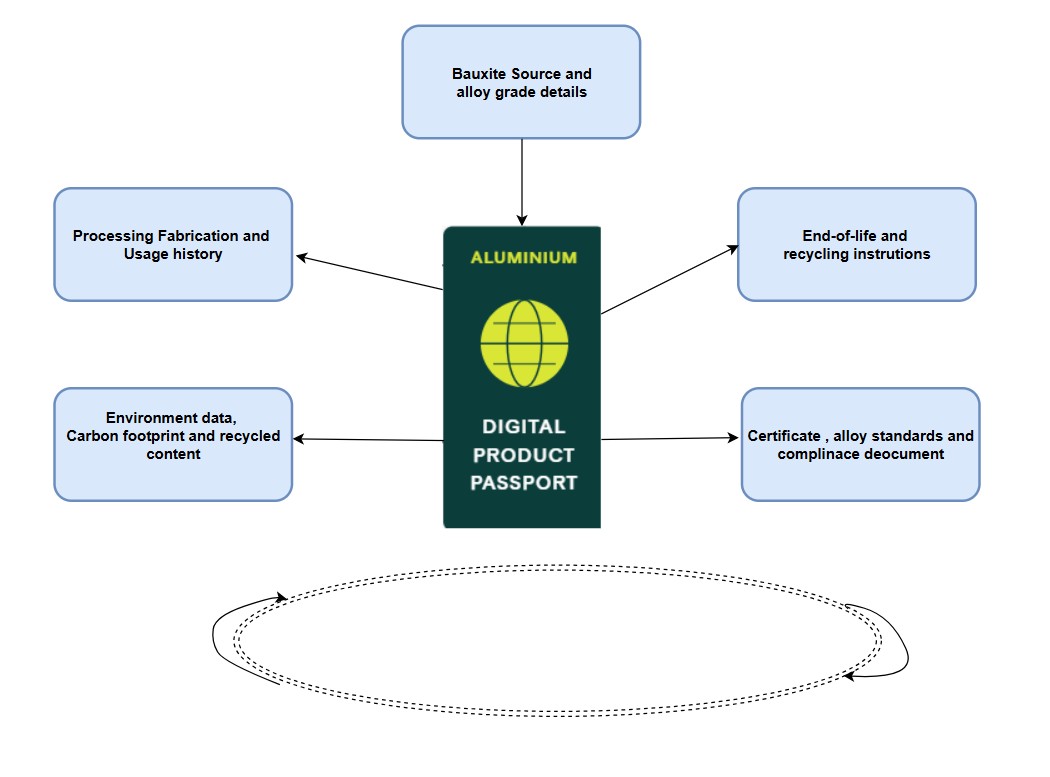
Your customers are about to ask you a question you cannot answer from a spreadsheet: "Can you prove where this aluminium came from, how much of it is recycled, and what your process did to it, in a format a machine can read?" That question is coming from the EU's Digital Product Passport (DPP), and aluminium has been named a priority material. Under the Ecodesign for Sustainable Products Regulation (ESPR), every semi-finished and finished aluminium product placed on the EU market will soon need to carry a machine-readable record of its origin, composition, carbon footprint, recycled content, and processing history. For anodisers sitting in the middle of the value chain, the DPP is not a distant policy headline. It is the next data obligation, and the operations that start capturing the right information now will be the ones still winning EU contracts in 2028.
What Is a Digital Product Passport?
A Digital Product Passport is a structured, digital record of a product's key sustainability and traceability attributes, accessible through a data carrier such as a QR code or RFID tag. Instead of a paper certificate that lives in a filing cabinet, the DPP travels with the product through its entire life, from raw material, through every processing step, to recycling or reuse.
The ESPR framework became law in 2024, and the DPP is its central enforcement tool. Semi-finished steel and aluminium products have been prioritised precisely because of the metal industry's economic weight and environmental impact. The underlying data standard is being finalised, with sector requirements expected to be published by 2027 and to enter into force no less than 18 months after publication.
Why Is Aluminium First in Line?
Aluminium sits at the intersection of two policy priorities: it is carbon-intensive to produce, and it is highly recyclable. That makes it the ideal proving ground for a passport designed to drive circularity. Regulators want to know, verifiably, how much recycled content is in a billet, how much carbon is embedded in it, and where it can go at end of life.
You may already have heard "digital product passport" in a narrower context. The EU Battery Regulation, for example, mandates one for EV batteries from 2027. The ESPR passport is broader and more fundamental: it applies to the aluminium material itself, upstream of any single end-use. Whether your components go into a car, a façade, or a laptop, the same underlying material passport follows the metal.
For anodisers, this creates a specific problem. You sit in the middle of the value chain. The DPP that your customer eventually issues will only be as accurate as the data you pass forward. If you cannot supply verified information about the aluminium you processed and what you did to it, you become the broken link in your customer's passport, and the easiest supplier to replace.
DPP vs. CBAM: A Critical Distinction
Many anodisers assume that because they are preparing for CBAM, they are covered for the DPP. They are not. The two regimes overlap but ask fundamentally different questions.
| Dimension | CBAM | Digital Product Passport |
|---|---|---|
| Core question | How much carbon is embedded? | What is this product made of, and where did it come from? |
| Trigger | Import into the EU | Placing a product on the EU market |
| Data scope | Emissions only | Carbon + recycled content + composition + traceability + durability |
| Output | Certificates & financial liability | A machine-readable passport that follows the product |
What Data Will Anodisers Need to Track?
While the final data model is still being ratified, the direction is clear. Anodisers should expect to contribute to the following passport fields for every batch they process:
- Material identity & alloy composition: the specific alloy grade of the aluminium entering your line.
- Recycled content: the proportion of post-consumer and pre-consumer scrap in the feedstock, carried forward from your supplier.
- Embedded carbon footprint: the cradle-to-gate emissions of the material, plus the emissions of your own anodising process.
- Processing history: anodising type (Type I/II/III), coating thickness, seal type, and any chemistry used, including declarations on restricted substances.
- Batch traceability: a unique identifier linking the finished component back to the exact bath, cycle, and material lot that produced it.
Notice how much of this you already generate on the shop floor, and how little of it is currently captured in a structured, exportable, auditable form.
The Hidden Opportunity: Recycled Content
The DPP's focus on recycled content collides directly with one of anodising's oldest quality headaches. Higher recycled-content billets carry more variable alloy impurities, which can cause streaking, colour mismatch, and inconsistent coating build. As brands push toward substrates with up to 94% post-consumer content to hit circularity targets, anodisers who can process recycled aluminium to a consistent finish and prove it hold a genuine commercial advantage.
In other words, the passport doesn't just document recycled content, it rewards the anodisers who have mastered it. Your traceability data becomes proof of capability, not just compliance.
Four Actions Anodisers Should Take Now
1. Digitise Batch Records
If your process parameters (coating thickness, bath chemistry, cycle time, material lot) still live on paper or in disconnected spreadsheets, that is the first thing the DPP will expose. Structured, digital, batch-level records are the foundation everything else builds on.
2. Demand Data From Your Suppliers
You cannot pass forward recycled-content and embedded-carbon figures you never received. Start requesting verified material data from your aluminium suppliers now, exactly as CBAM has trained you to do. The DPP simply widens the set of fields you need.
3. Establish End-to-End Traceability
Every finished component should be linkable back to the specific batch, bath, and material lot that produced it. This is the single hardest DPP requirement to retrofit, and the one that most rewards automated data capture.
4. Treat the Passport as a Sales Asset
Anodisers who can hand a customer clean, verified, passport-ready data will win work from those who force customers to chase it. Position your traceability capability as a differentiator in tenders, not a back-office cost.
The Bottom Line
The Digital Product Passport turns data into a condition of market access. Unlike CBAM, there is no certificate to purchase your way through. The information either exists in your systems, batch by batch, or it doesn't. The anodisers who begin capturing structured, verified, traceable data today will glide into DPP compliance and use it to win contracts. Those who wait will find themselves the broken link in their customers' passports, scrambling to reconstruct data that was never recorded.
The requirements arrive by 2027. The data you would need to prove your 2027 processing is being generated on your line right now. The only question is whether you are capturing it.
How AluMind Can Help?
AluMind's AI platform makes your anodising line passport-ready, automatically:
- Batch-level capture of process parameters and chemistry
- End-to-end traceability from material lot to finished component
- Embedded carbon and recycled-content tracking
- Export-ready records aligned to emerging DPP standards
Turn the Digital Product Passport into an advantage, not a scramble. Contact AluMind to start capturing the data your customers will soon demand.